

As a SaaS agreement lawyer, here is my early read on Google’s new AI agent terms: you can own the agent you build, but Google keeps everything it brought to the table. Google’s updated Workspace terms (effective October 12, 2026) say Google does not claim the agents you build, but only to the extent they contain no pre-existing Google IP, and Google owns its own agents outright.
That one sentence is going to show up in a lot of contracts. Google has now put AI agent ownership in writing for every Workspace customer on its online terms, and if you build or sell software with agents in it, your customers (and their lawyers) are going to start asking you the same question. I represent lots (literally 100s and 100s) of SaaS companies as their software attorney, so let me walk through what Google actually said, where the line falls, and what to do in your own paper.
Three Kinds of Agents.
Google rewrote Sections 12 and 13 of the Google Workspace Service Specific Terms. An AI agent is a goal oriented system that performs tasks for the customer, supervised or autonomous. Then Google sorts agents into three buckets, and ownership turns on which bucket you are in.
- Google AI Agents. Agents Google builds and offers in Workspace. Google owns all the IP.
- Customer AI Agents. Agents you create, including by customizing agent instructions in Workspace Studio, or agents you own and deploy in Workspace. Google does not assert ownership, minus any pre-existing Google IP.
- Third Party AI Agents. Agents someone else built or owns. Same deal: Google does not claim them, minus any Google IP inside, and their use is governed by the third party’s terms.
You Own the Agent. Google Owns the Pre-Existing.
Think of it like building a house on leased land. The house you designed is yours. The land, the utility lines, and the prefab walls the landlord supplied are not.
So for an agent you build in Workspace Studio:
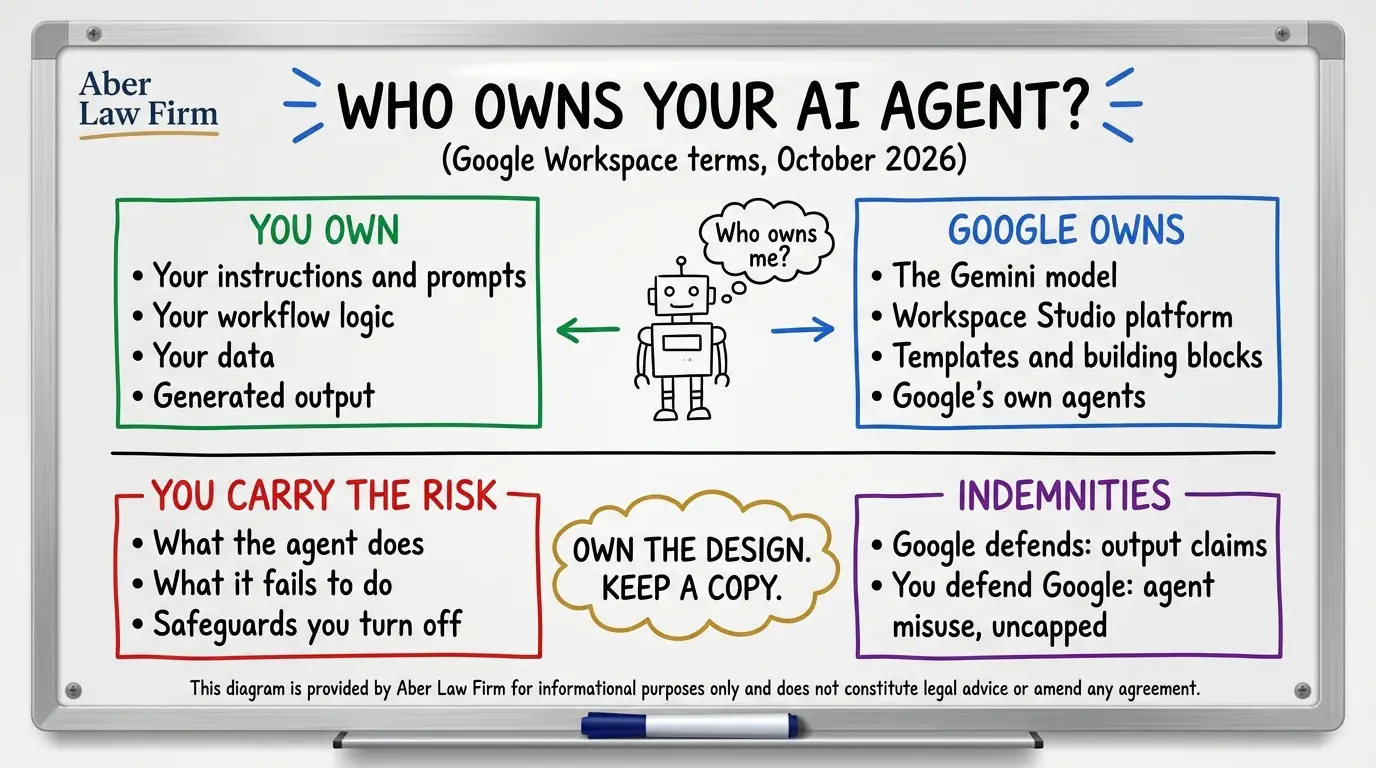
- Yours. Your instructions and prompts, your workflow logic (what triggers it, what it checks, what it does next), the connections you chose, your data, and the content the agent generates.
- Google’s. The Gemini model underneath, the Workspace Studio platform, any building blocks or templates Google supplied, and any Google agent you started from and customized.
Two things are easy to miss. First, Google’s wording is a promise not to claim ownership. It is not an assignment and not a license. Google is not handing you rights; it is staying out of the way of whatever rights you already have. (Whether your prompts and workflow logic are protectable IP on their own is a separate, unsettled question.)
Second, the carve out is broad. Every agent built in Workspace Studio sits on Google’s platform from the first click, so most of the agent’s “engine” is pre-existing Google IP. What you truly own and can take with you is the design: the instructions, the logic, and the data. If portability matters, keep a written copy of your agent’s instructions and logic outside the platform. That copy is the asset.
Agent, Output, and Action Are Three Different Things.
Google treats the agent, what it writes, and what it does as separate categories, with different rules for each.
- The agent. Ownership follows the three buckets above.
- The output. Text and content Gemini generates is your Customer Data, and Google claims no ownership in it. That did not change.
- The action. Sending the email, booking the meeting, moving the file. Google calls these “Agentic AI Actions,” says expressly they are not output, and includes an agent’s failures to act.
Owning the thing and owning what the thing does are not the same, and that brings us to risk.
Ownership Comes With Responsibility.
The customer is solely responsible for any Agentic AI Action, for deciding whether an agent fits the job, for authorizing what data and systems it can reach, and for supervising it in production. Turn off a human confirmation safeguard, and the liability from that is yours too. Because the definition reaches actions “attributable to” Google’s own agentic service, the shift arguably covers Google’s agents as well (Google did not expressly disclaim its own agents, so there is room to argue).
Google also disclaims all liability and indemnity for agents you build, third party agents, and any outside service an agent touches. Its own liability stays capped at 12 months of fees for the affected services, or $5,000 for anything free.
The Indemnities, Both Directions.
Google to you. Google still defends you against claims that unmodified output from a paid, listed AI service infringes someone’s IP, and against claims about Google’s training data. That covers output, not agent actions, and it arguably drops away for output from an agent you built, since Google disclaims indemnity for customer agents.
You to Google. This is new. Under the updated Google Cloud Terms of Service, the customer defends Google if the customer or its users use the services or any AI agent in breach of Google’s acceptable use policy or use restrictions. Indemnities sit outside Google’s liability cap, so this one is uncapped, and there is no fault requirement. Google’s own Agentic AI Responsible Use Guidelines admit agents can go off script and are open to prompt injection. (For Workspace customers on Google’s online terms, Google’s change clause delays material changes to the main Cloud terms until your order term renews.)
What SaaS Vendors Should Take From This.
You are likely on both sides. Upstream, you build on a model provider. Downstream, customers build agents on your product and will quote Google back to you.
- Write an agent ownership clause. If customers build agents in your product, say who owns them in your SaaS agreement. Google’s structure is a good starting point: the customer owns its instructions, configurations, and output, and you own the platform, your models, your templates, and everything that existed before.
- Define “pre-existing” on purpose. Spell out what you are keeping: the platform, prebuilt agents and templates, improvements to your product, and general know-how. Vague carve outs create fights.
- Grant the license, not just a non-assertion. Your customer needs the right to run its agent on your platform. Say so plainly, for the subscription term.
- Keep your learnings. Make sure you can use aggregated, de-identified usage data and feedback to improve the product, without touching the customer’s agent design or data.
- Separate output from action in your indemnity. Decide whether your IP indemnity covers what an agent produces, what it does, or neither, and carve out agents the customer builds and outside connectors you do not control.
- Do not copy Google word for word on risk. Google has leverage you do not. Enterprise buyers will push back on “you are solely responsible for whatever our agent fails to do.” The middle ground that usually works: you are responsible for your agent working as documented, and the customer is responsible for its instructions, permissions, and use.
Questions I Get as a SaaS Agreement Lawyer.
Who owns an AI agent built on someone else’s platform? Whoever the contract says, and the platform almost always keeps its own technology. Under Google’s terms, you keep what you designed and Google keeps everything that was already there.
Can I move my Workspace agent to another platform? You can move your design (instructions, logic, and data). You cannot take Google’s model, platform, or templates with you, so plan on rebuilding the engine somewhere else.
Who owns AI generated content? Between you and your AI vendor, whoever the contract says. Google treats what Gemini writes as your Customer Data and claims no ownership in it. Whether anyone can hold a copyright in purely AI generated content is a different question: in Thaler v. Perlmutter, the D.C. Circuit held that copyright requires a human author, and the Supreme Court declined to review that ruling in March 2026. So the contract does most of the work here, too.
If I customize a Google agent, is it mine? Partly. Google calls a customized agent a Customer AI Agent, but the underlying Google agent is still pre-existing Google IP. You own your customizations, not the agent you started from.
These terms are brand new, and nobody has litigated them yet, so expect them to evolve. If customers are building agents on your product and your agreement does not say who owns them yet, that is exactly what a SaaS lawyer should fix before your next enterprise deal. Reach out and we can take a look at your SaaS contract. I hope this helps.
Last updated: October 24, 2026.
Resources:
- Few Thoughts on Machine Learning Agreements or AI Agreements
- AI Features and Automated Decision Making: What You Owe Your Customers
- Indemnity vs Breach of Contract Claim in a SaaS Terms of Service?
- Limitation of Liability Clause: The One Word That Cost a Vendor $1.88 Million
Disclaimer:
This post is for informational and educational purposes only, and is not legal advice. You should hire an attorney if you need legal advice, which should be provided only after review of all relevant facts and applicable law.
Discover more from Aber Law Firm
Subscribe to get the latest posts sent to your email.