
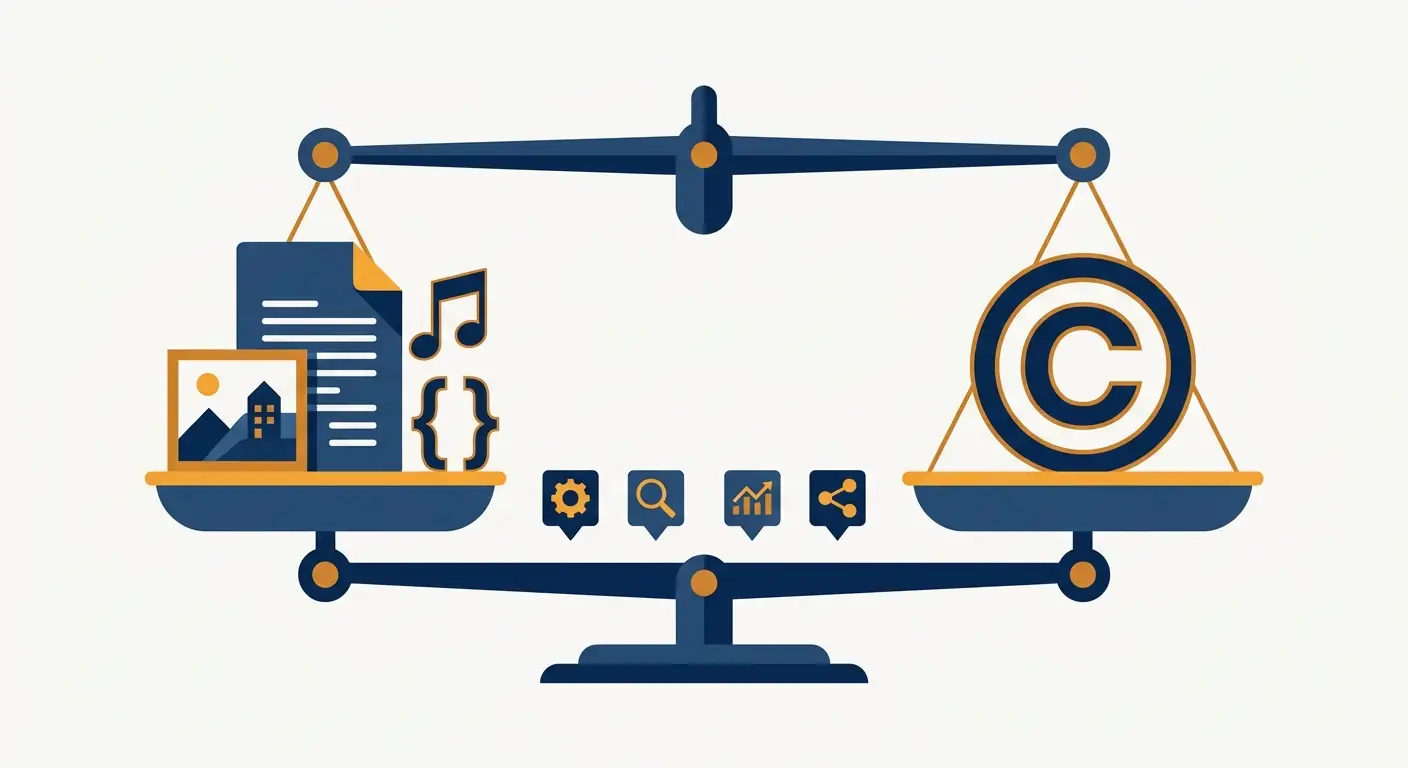
Short answer: fair use is a legal doctrine that lets someone use a copyrighted work without permission in limited situations, decided by weighing four factors. It is a defense, not a right you can count on in advance, so for a software company it is both a shield (when you use others’ content) and a risk (when others copy yours).
People ask me all the time whether they can use someone else’s work: a photo, a chunk of text, a logo, a piece of code. Fair use is the doctrine that sometimes says yes. The honest answer is almost always “it depends,” because courts run a four-part test under 17 U.S.C. 107 and weigh the results case by case.
1. Purpose and Character of the Use.
- Commercial use weighs against fair use; nonprofit or educational use weighs for it.
- Commentary, criticism, news reporting, and parody weigh for fair use.
- “Transformative” use that adds new meaning or purpose weighs for fair use; merely repackaging the original weighs against it.
One caution: the Supreme Court narrowed how far “transformative” stretches in Andy Warhol Foundation v. Goldsmith (2023). If your use serves the same commercial purpose as the original, calling it “transformative” will not save you.
2. Nature of the Copyrighted Work.
Factual works (a manual, a database of facts) lean toward fair use. Highly creative works (a song, a photograph, a novel) lean against it. The more expressive the original, the more protection it gets.
3. Amount and Substantiality Used.
How much did you take relative to the whole, and did you take the “heart” of it? Using a small, non-central portion weighs for fair use. Copying the most important part, even if it is short, weighs against it.
4. Effect on the Market.
This is often the most important factor: does your use harm the actual or potential market for the original? If you are substituting for the thing the owner sells or licenses, that cuts hard against fair use. If you are right that it is fair use, you can use the work without permission; if you are wrong, you can be on the hook for infringement, including statutory damages.
Why This Matters to a Software Company.
Fair use shows up for vendors in two directions. As a user of content, it is what sometimes lets your marketing team quote, comment on, or build on third-party material, though leaning on it is riskier than getting a license or using clearly-licensed material (see Creative Commons and Who Owns Your Marketing Content). On the code side, fair use is the doctrine behind lawful reverse engineering for interoperability (see Reverse Engineering Software), and it is what the Supreme Court relied on in Google v. Oracle when it held that copying Java’s API declaring code was fair use. As a rights-holder, fair use is the gap that lets some copying of your work happen even though you own the copyright.
The internet pushed this issue to the front, a classic example of technology and law colliding. The practical takeaway: fair use is a real doctrine, but it is a judgment call, not a guarantee. When the stakes are meaningful, get a license or get advice before you rely on it. I hope this helps.
For the foundational frame on the four IP regimes that protect software businesses, see Intellectual Property Basics for Software Companies.
Common Questions About Fair Use.
What are the four fair use factors? Purpose and character of the use, the nature of the work, the amount used, and the effect on the market. Courts weigh all four together, and no single factor decides it.
Is fair use a right? No. It is a defense you raise after the fact, not permission you can rely on in advance.
Does “transformative” guarantee fair use? No. After Warhol v. Goldsmith (2023), a use that serves the same commercial purpose as the original is not saved just by calling it transformative.
Resources:
- U.S. Copyright Office Fair Use Index
- 4 Things to Remember About Copyright Law
- Copyright Issues: SaaS Software
- Intellectual Property Basics for Software Companies
Disclaimer:
This post is for informational and educational purposes only, and is not legal advice. You should hire an attorney if you need legal advice, which should be provided only after review of all relevant facts and applicable law.
Discover more from Aber Law Firm
Subscribe to get the latest posts sent to your email.