
Short answer: your software infringement indemnity should cover only your software, not your software combined with the customer’s or a third party’s technology. In AFLAC v. Intervoice, the vendor owed no indemnity because the infringement claim arose from that combination.
This is what to know about the “combination exception” to infringement indemnities.
As a software licensing attorney I run into infringement indemnity issues all the time. These risk-shifting clauses confuse clients, so let me explain the combination claim exception with a real case.
A contractual indemnity is essentially an insurance policy: the customer is asking you to insure them if your software infringes someone else’s IP. They expect you to defend them in an infringement suit (sometimes hiring their own counsel and sending you the bill) and to pay any judgment. It is a common ask from large customers.
The Combination Claim Exception.
There are standard exceptions to a vendor’s indemnity, carve-outs for risks the vendor should not own. One of the most important is the combination claim exception. The theory: your indemnity should cover only your software, not your software plus some other technology (the customer’s or a third party’s).
The Facts of AFLAC v. Intervoice.
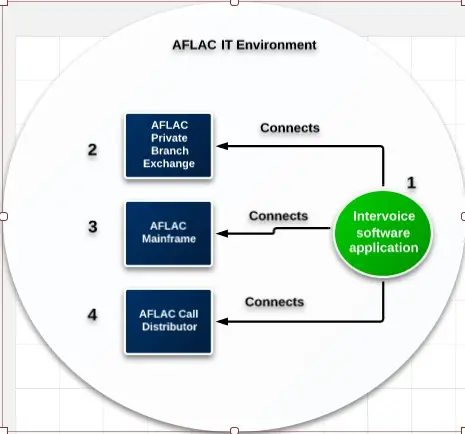
Intervoice’s software was deployed on premises at AFLAC, and AFLAC was then sued for patent infringement. Intervoice’s software alone did not infringe; the allegation arose only when AFLAC combined the Intervoice software with certain other technology. The court held Intervoice did not have to indemnify AFLAC, because the claim arose from the combination, which the contract’s combination exception expressly excluded. The carve-out did exactly what it was drafted to do.
The map above is the whole case in one picture. The Intervoice application is the only thing Intervoice sold. Everything it touches, the private branch exchange, the mainframe, and the call distributor, is AFLAC’s own equipment. The patent claim read on the assembled system, not on the vendor’s software, and the vendor had bargained for exactly that line.
What This Means for Your Indemnity.
If you want to give a broader indemnity, that is a business decision, but at least understand the combination issue before you do. Carving out combination claims will not put you out of step with the industry: both Oracle and Microsoft include a combination exception in their agreements. It also pairs with the other indemnity levers, the scope of the defense and the relationship to your limitation of liability.
How to Draft the Carve-Out So It Actually Holds.
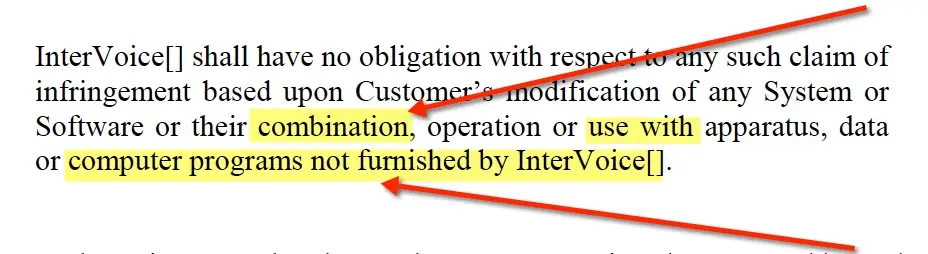
That is the clause that carried the day, and it is worth reading closely. A combination exception is only as good as its wording, and AFLAC v. Intervoice is really a drafting lesson. When I write one for a vendor client, I cover the predictable ways a customer creates the very combination it later wants me to insure. I exclude claims arising from (1) combining the software with hardware, software, or data I did not supply, (2) modifications the customer or a third party makes, (3) use outside the documentation or the license scope, and (4) the customer’s continued use of an old release after I have offered a non-infringing update. Each of those is a risk the customer controls, not me, so the customer should own it. I also tie the exception to causation: the carve-out should bite when the combination or modification is what gives rise to the claim, so a customer cannot dodge it by pointing to some incidental use of my software. Finally, I pair the carve-out with a duty to mitigate, my right to procure a license, modify the software, or replace it, so the indemnity has a defined exit instead of an open-ended check. Drafted this way, the exception is not a loophole. It simply matches who controlled the risk to who pays for it.
Frequently Asked Questions.
What is the combination exception? A carve-out stating your infringement indemnity does not apply when the claim arises from your software combined with technology you did not supply. It keeps you off the hook for the customer’s own integration.
Is excluding combination claims unusual? No. It is standard. Oracle and Microsoft both use it, so carving out combination claims keeps you in line with the software industry.
Why did Intervoice owe nothing in the AFLAC case? Because the patent claim arose only from combining Intervoice’s software with other technology at AFLAC, and the contract’s combination exception expressly excluded that scenario.
I hope this helps.
For the foundational distinction between an indemnity claim and a breach-of-contract claim, which drives every indemnity negotiation, see SaaS Indemnity vs. Breach of Contract: What’s the Difference?
Resources:
Appellate Decision in AFLAC v. Intervoice
Disclaimer:
This post is for informational and educational purposes only, and is not legal advice. You should hire an attorney if you need legal advice, which should be provided only after review of all relevant facts and applicable law.
Discover more from Aber Law Firm
Subscribe to get the latest posts sent to your email.