
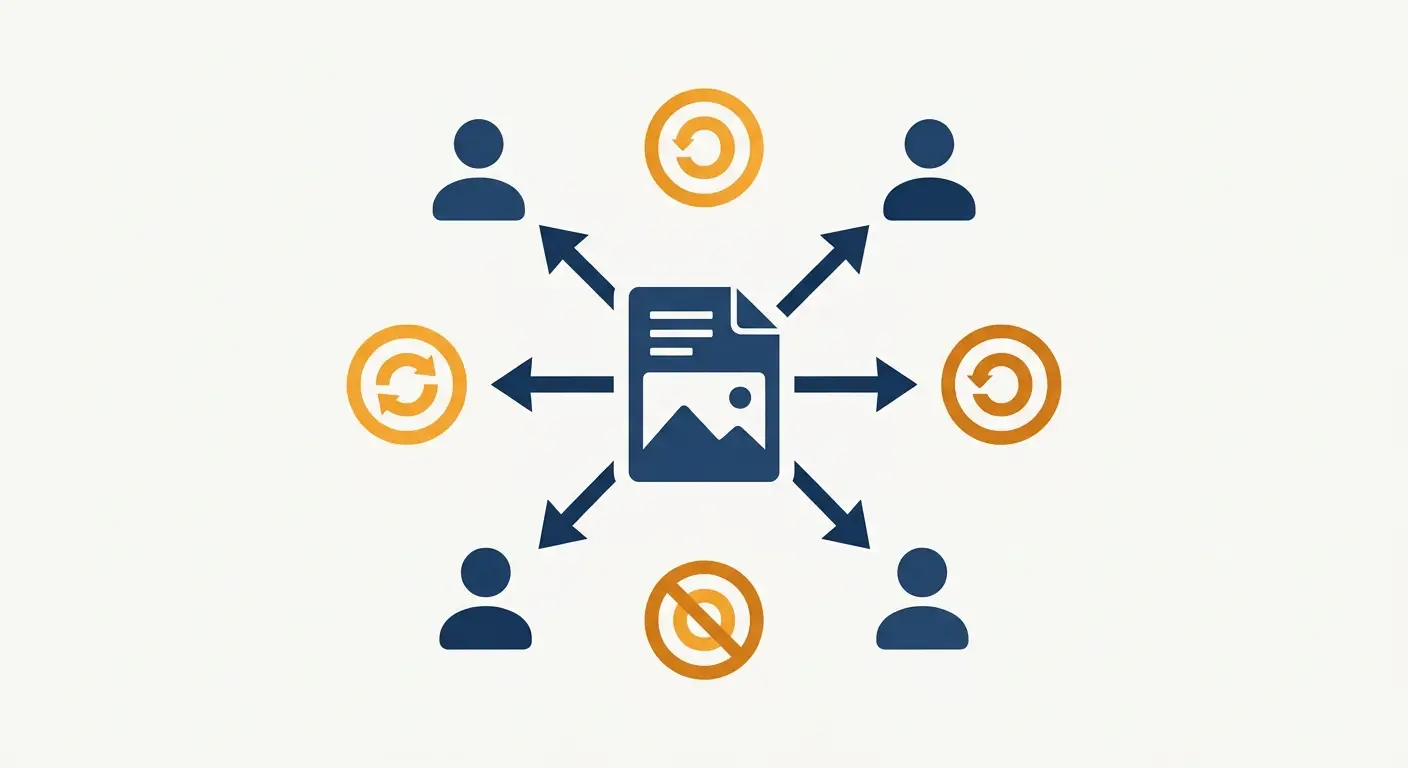
Short answer: Creative Commons is a free, standardized way to license copyrighted content from “All Rights Reserved” to “Some Rights Reserved,” and as a software company you should use it for your blog and marketing, never for your software or your documentation. Knowing how it works also keeps you from accidentally pulling someone else’s CC-licensed content into your product on terms you never read.
Any software or SaaS executive should understand the Creative Commons (CC) license program, even though it does not directly touch your EULA or SaaS contract. It is a big deal in how copyrighted material gets licensed online, and the traps are easy to step in.
What the Creative Commons Program Is.
Creative Commons is a non-profit that publishes free, standardized copyright licenses. Instead of every creator writing a custom license, you pick a CC license and signal it with simple icons, a human-readable summary, a real legal license underneath, and embeddable code. It moves a work from the default “All Rights Reserved” to a clear “Some Rights Reserved.” (More info here.)
The License Flavors.
The licenses are built from a few modular conditions: Attribution (BY, give credit), ShareAlike (SA, adaptations must carry the same license), NonCommercial (NC, no commercial use), and NoDerivatives (ND, no adaptations). Mix those and you get the six common CC licenses, plus CC0 for dedicating a work to the public domain. The two conditions a software company has to watch are ShareAlike, which behaves like copyleft and can force your downstream work to carry the same license, and NonCommercial, which can quietly bar the exact business use you had in mind.
What You Should and Should Not Use It For.
- Do not use CC for your software. Creative Commons says this directly. Software should be licensed under a real software license, whether proprietary or an OSS license like MIT, Apache, or the GPL family if you go open source. The frameworks that actually matter for code are the open source ones, which I walk through in Linking and the GPL.
- Do not use CC for your documentation. Even though CC suggests it is fine, I tell clients to keep docs proprietary and license them alongside the software. Your docs are part of the product.
- Do use it for blog and marketing content where you want reach, especially viral or sharable material. That is where “Some Rights Reserved” actually helps you.
The Trap: Pulling CC Content Into Your Product.
The bigger risk for most vendors runs the other direction. Your team grabs a CC-licensed image, icon set, or snippet and drops it into the product or a sales deck without reading the conditions. If it was ShareAlike, you may have triggered an obligation you never intended. If it was NonCommercial, you may be infringing outright. Treat inbound CC material with the same discipline you apply to inbound open source code, which is exactly what a real open source policy is for (see Open Source Compliance and SBOM).
There is more to learn, but CC is a useful tool when you use it on purpose. Talk to your copyright attorney first. I hope this helps.
For the foundational frame on the four IP regimes that protect software businesses, see Software Copyright Lawyer for Vendors.
Common Questions About Creative Commons.
Can you use a Creative Commons license for software? No. Creative Commons itself recommends against it. Use a real software license, proprietary or an OSS license like MIT, Apache, or the GPL.
Which CC conditions are risky for a business? ShareAlike (it behaves like copyleft and can force your downstream work to carry the same license) and NonCommercial (it can bar the exact commercial use you intended).
What should a software company use Creative Commons for? Blog and marketing content you want shared widely, never your software or your product documentation.
Resources:
- About CC Licenses (Creative Commons)
- Linking and the GPL (Technical and Legal Analysis)
- What is Fair Use?
- Software Copyright Lawyer for Vendors
Disclaimer:
This post is for informational and educational purposes only, and is not legal advice. You should hire an attorney if you need legal advice, which should be provided only after review of all relevant facts and applicable law.
Discover more from Aber Law Firm
Subscribe to get the latest posts sent to your email.