
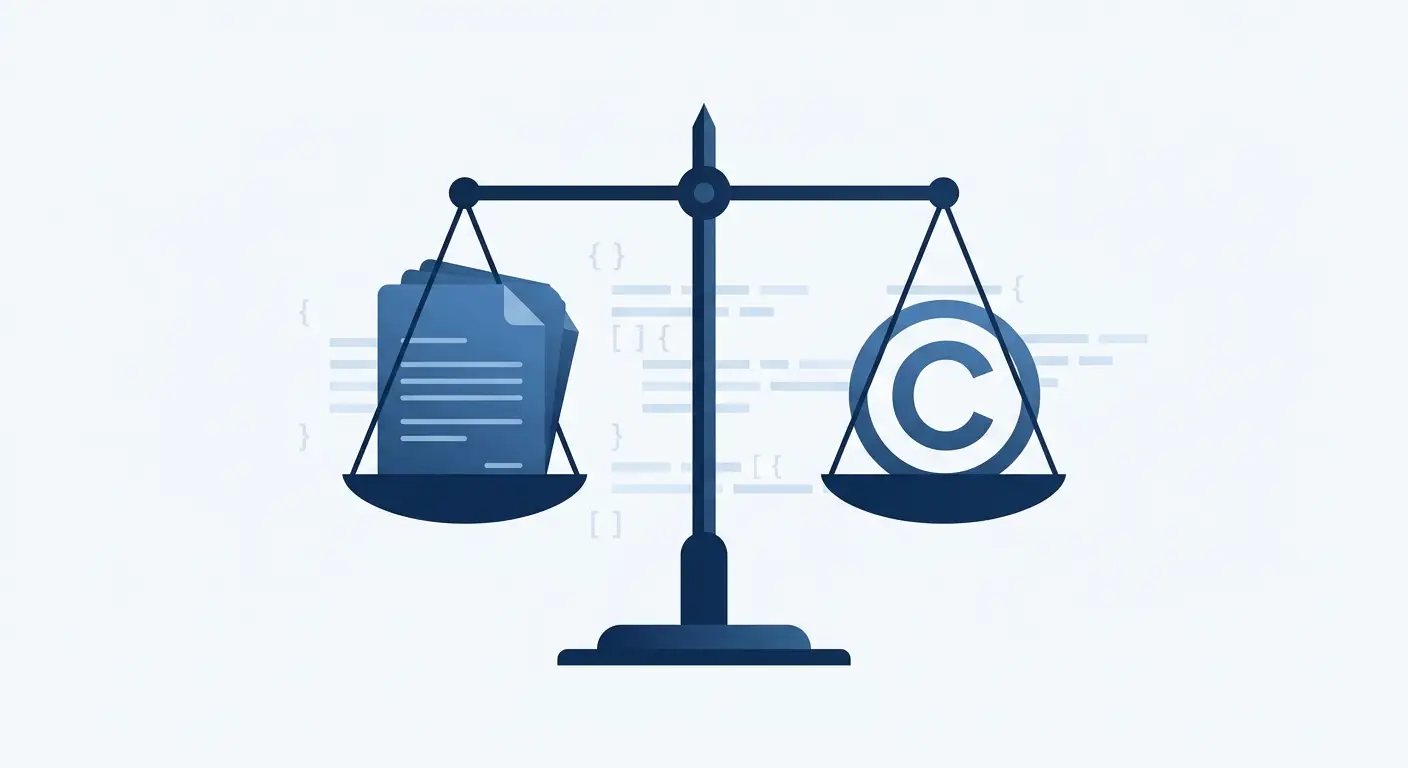
Short answer: copyright protects your software automatically, but a license agreement (a contract) lets you define and limit exactly how the customer may use it. Smart software companies rely on the right mix of both, not one alone.
While this is a complex legal issue, let me try to simplify it: do I need a software licensing agreement, or can I rely on copyright alone?
One way to protect IP is via copyright law alone, with no contract, where the owner relies on federal copyright law to give the buyer their rights and to protect the owner.
For example, if you buy a book you own the tangible book, but the author or publisher still owns the copyright. You can read it, write on it, tear it up, or transfer it, but you cannot copy it, prepare derivative works (movies), or publicly perform it. For those answers you look to copyright law, specifically the owner’s exclusive rights under 17 U.S.C. section 106.
On the other hand, if you buy software and agree to a license agreement (a contract), then the contract and federal copyright law together protect the owner and determine your rights. Read the agreement first, because it explains what you can and cannot do.
Music owners learned the hard way (the original Napster) that relying only on copyright, with no contract, has serious consequences in the digital world. iTunes music is licensed, digital images are licensed, and software is still licensed.
What Copyright Does Not Cover.
Copyright is powerful but narrow. It gives you the exclusive rights to copy, distribute, publicly perform, and make derivative works, and it lets you sue infringers with real teeth if you registered with the U.S. Copyright Office, including statutory damages. But copyright says nothing about the things a software business negotiates every day. Copyright tells the world it cannot copy your code; only your contract tells the paying customer how it may actually use it. Copyright does not cap the number of users, limit use to one module, set a subscription term, a warranty, a support obligation, a limitation of liability, or what happens to the customer’s data on termination. It also does not, by itself, stop a paying customer from using the product in ways you never intended but that are not technically “copying.” Those gaps are exactly where a contract earns its keep.
Why You Want Both.
Copyright gives you a strong default, but a license contract fills the operational gap, and it can grant rights copyright does not (like permission to use at all) while limiting rights the customer might otherwise assume. The key is the right mix: copyright as the backstop, the license agreement as the operating manual. All software and IT companies should understand how the two work together to protect their IP and to give users the rights to use the technology.
The Practical Move for a Software Vendor.
Do two things and you have both layers working for you. First, register the copyright in your code, because registration is what unlocks statutory damages and attorney’s fees and makes infringement worth pursuing. Second, put a real license agreement in front of every customer that defines the grant, the metric, the restrictions, the warranty, and the termination terms. Copyright is the floor you stand on when someone steals the product outright. The contract is how you run the relationship with the customers who pay you. The same precision shows up in the restrictions you write into the license.
Frequently Asked Questions.
Do I need a license if copyright already protects my code? Yes. Copyright stops copying, but only a contract sets users, modules, term, warranty, liability, and data-return terms. You want both layers.
Does registering my copyright matter if I have a strong contract? Yes. Registration unlocks statutory damages and attorney’s fees, which is what makes pursuing an infringer economically worthwhile.
Can a contract give rights copyright cannot? Yes. A license grants the permission to use at all, and can limit use in ways copyright never addresses, which is why the contract is your operating manual.
I hope this helps.
For the foundational frame on the four IP regimes that protect software businesses, copyright, trademark, patent, and trade secret, see Intellectual Property Basics for Software Companies.
Disclaimer:
This post is for informational and educational purposes only, and is not legal advice. You should hire an attorney if you need legal advice, which should be provided only after review of all relevant facts and applicable law.