
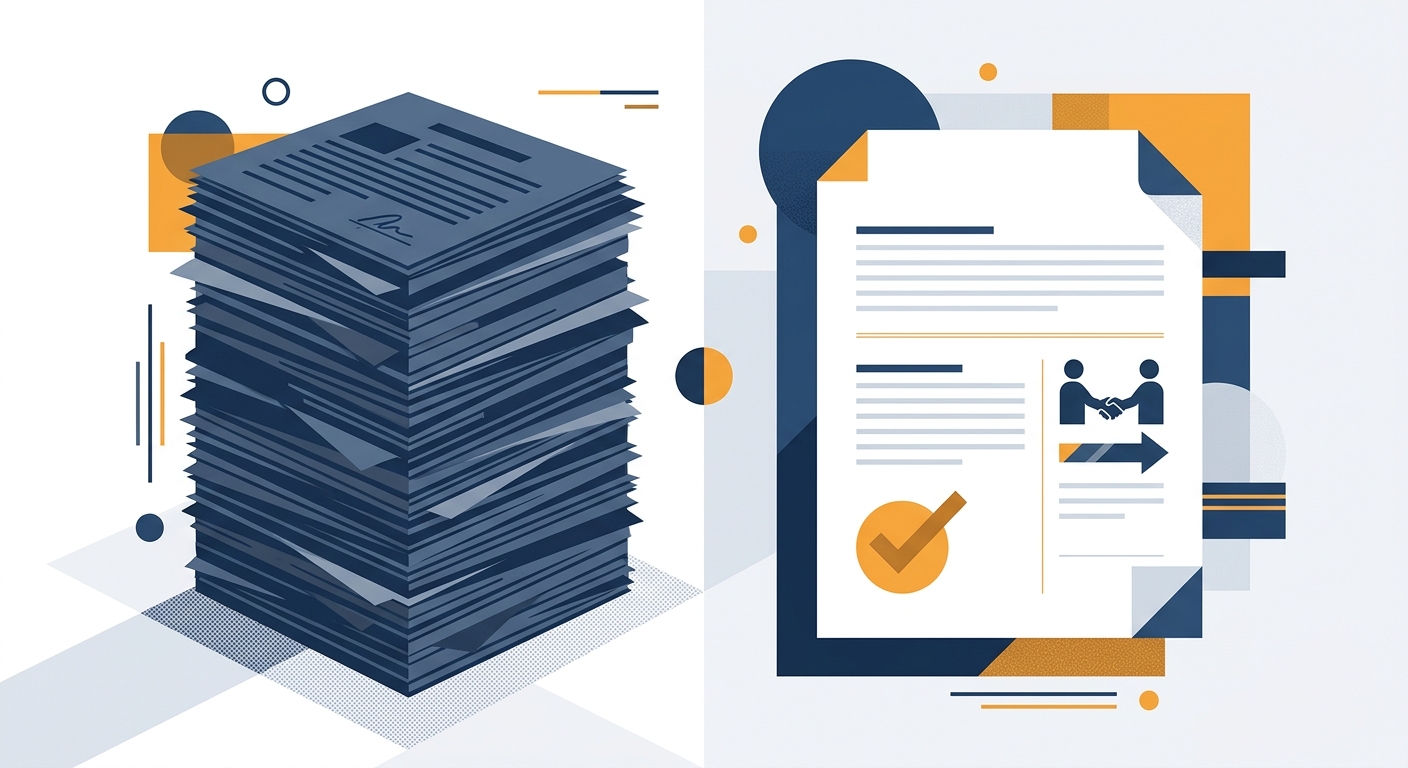
Short answer: your SaaS agreement template is a sales document as much as a legal one. If it is long, formal, and hard to read, it slows deals. So do not hand the whole job to the lawyers. Make readability a requirement.
Seth Godin made a great point about marketing once, that it is “too important to be left to the marketing department.” As a software attorney, it triggered the same thought for me about contracts. Your SaaS agreement template is too important to leave to the lawyers. Let me explain.
Most IT companies use end-user agreements straight from their outside lawyers. Those agreements look corporate and formal. They are also long and far too complex. IBM and Oracle saw this early. They brought in non-lawyer consultants to help legal simplify their agreements, because they realized the paper itself was getting in the way of closing deals. Most companies cannot afford a team of consultants. But you can refuse to accept that complexity and length in your template. So challenge your lawyers to simplify and shorten it. Remember, lawyers bill by the hour, so a longer agreement is not always working in your favor. And a shorter, clearer agreement is far easier to explain to a judge or jury later.
What “Too Important to Leave to the Lawyers” Looks Like.
It does not mean cutting protection. It means making three demands of whoever drafts your paper:
- Plain English, short sentences. If a non-lawyer on the buyer’s side cannot read a clause once and get it, it will generate questions, redlines, and delay. The federal plain language guidelines are a good model, and plain language is a recognized discipline, not a dumbing-down.
- Only the terms you actually need. Boilerplate that does not fit your model adds length without adding protection. Every extra page is another place for the deal to snag.
- Built for your sales motion. A click-through, self-serve product and a six-figure enterprise deal should not use the same 30-page document.
Why a Shorter Template Wins.
A shorter, clearer agreement closes faster and survives procurement with fewer redlines. Length is not strength; a contract a buyer can read is a contract a buyer will sign. And if your paper ever lands in front of a judge or jury, plain language is far easier to explain and enforce. So do not put a dense template in front of a customer and expect a quick signature.
What to Cut and What to Keep.
Shortening a template is not about deleting pages at random. It is about knowing which clauses earn their place. Keep the terms that allocate real risk: your limitation of liability, your IP ownership and license grant, your warranty disclaimer, confidentiality, and termination. Those clauses do work in a dispute, and cutting them is how vendors get hurt. The pages you can usually lose are the ones that do not fit your model: a long assignment-and-assumption section for a product nobody assigns, elaborate source code escrow language for a pure SaaS offering, or force-majeure and notice provisions written for a 1990s software license. A good test is to ask, for every clause, what breaks if this is gone. If the honest answer is nothing, it is friction, not protection. Run that pass once a year, because templates collect clauses the way a garage collects boxes. Each redline you accept on a live deal has a way of migrating back into the master, and before long your clean template is somebody else’s lawyer’s paper. Owning that cleanup is part of treating the contract as a sales asset, not just a legal one.
Frequently Asked Questions.
Does a shorter agreement mean less legal protection? No. You keep the terms that allocate real risk, like your limitation of liability and IP ownership. You cut the boilerplate that adds pages without adding protection.
Should I use one template for every deal? No. Match the paper to the motion. A self-serve clickwrap and an enterprise MSA serve different buyers and should look different.
How do I get my lawyer to simplify? Ask for it directly, and treat readability as a requirement. Push for plain English, short sentences, only the terms you need, and a structure built for your sales process.
For the foundational decision of which template you even need, see SaaS Agreement vs. Software EULA: Which Template Do I Need? On trimming the paper you already have, see Who Else Is Streamlining Their Agreements? And for deciding what belongs in the contract versus a changeable policy, see Contract or Policy?
Disclaimer:
This post is for informational and educational purposes only, and is not legal advice. You should hire an attorney if you need legal advice, which should be provided only after review of all relevant facts and applicable law.
Discover more from Aber Law Firm
Subscribe to get the latest posts sent to your email.