
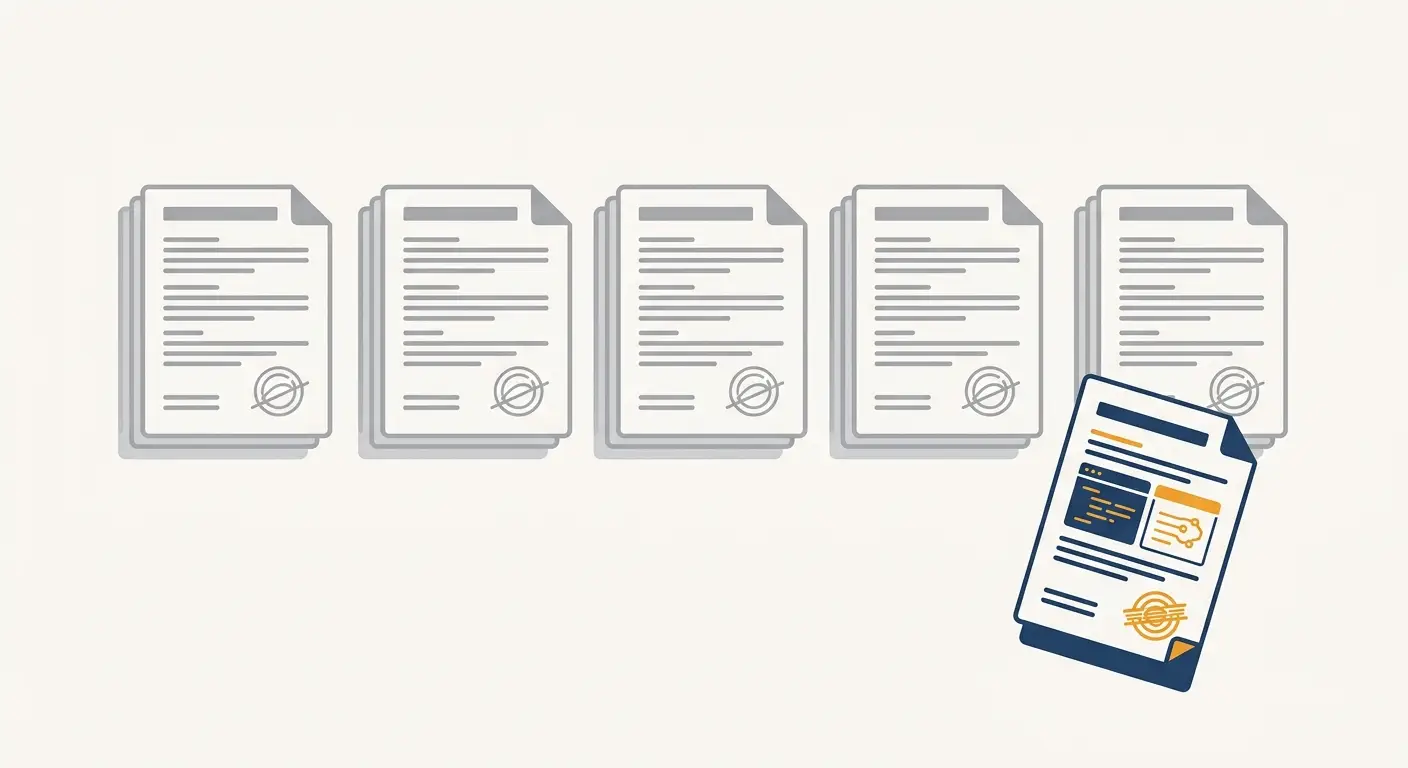
Short answer: no. SaaS agreement templates have not become commoditized, because the document does more than allocate risk. It explains your specific SaaS model to the customer. A $99 form can be a fine starting point, but it has to be checked against how you actually operate.
As a software attorney, I genuinely think about questions like whether SaaS agreement templates have become commoditized, meaning interchangeable and no longer meaningfully different from one company to the next. My answer is no, and I think it will stay no. Here is why that matters to your business.
The $99 Form Market.
There are plenty of websites selling SaaS and software form agreements for less than $100, and for a company on a tight budget they can be a reasonable place to start. I am not going to pretend otherwise. But “a place to start” is the operative phrase. As an attorney I would always recommend you have a form reviewed before you rely on it, to confirm it actually fits your model and does not quietly give away something important.
Why the Agreement Is Not Just Risk Allocation.
Here is the part the commoditization argument misses. A SaaS agreement does two jobs. The first is obvious: allocating risk through the limitation of liability, warranties, and indemnities (the clauses I dig into in What Does Your SaaS Agreement Liability Model Look Like?). The second job is quieter but just as important: your agreement explains and educates the customer on how your SaaS model actually works and what they are getting, because nothing tangible changes hands. Even the NIST definition of cloud computing treats SaaS as a distinct service model with its own characteristics. That second job is inherently specific to you.
Why One Company’s Form Should Not Be Another’s.
Two SaaS businesses can look similar and still have very different models under the hood: who owns the data, what the customer is restricted from doing, what is warranted, how support and service levels work, how renewal and payment are structured, whether the subscription is transferable, and on and on. Drop Company A’s form onto Company B and you can end up promising things you do not do, or failing to address the things that actually matter to your deal. The form reads fine. It just is not describing your business.
So What Should You Do?
I am not saying never buy a form online. I am saying that if you do, have it reviewed by an attorney who works with contracts of that type regularly, so it fits your model instead of someone else’s. The same logic is why a yearly tune-up of your paper pays off (see the EULA and SaaS contract tune-up), and why the agreement should not try to double as your product manual (see SaaS Agreements Are Not Good Communication Vehicles). Get the model right and the form becomes an asset instead of a liability. I hope this helps.
For the foundational decision between an EULA structure and a SaaS subscription structure (the first thing a form needs to get right), see SaaS Agreement vs. Software EULA: Which Template Do You Need? This is also exactly what we handle in our SaaS contract work.
Common Questions About SaaS Agreement Templates.
Can you use a $99 SaaS agreement template? As a starting point, yes. But have it reviewed so it fits your actual model and does not quietly give something away.
Why is a SaaS agreement not commoditized? Because it does two jobs: allocating risk and explaining your specific SaaS model to the customer. The second job is unique to your business.
What makes one company’s form wrong for another? Data ownership, use restrictions, warranties, support and service levels, renewal, payment, and transferability all differ. A form that reads fine may simply not describe your business.
Resources:
- What Does Your SaaS Agreement Liability Model Look Like?
- SaaS Agreements Are Not Good Communication Vehicles
- SaaS Contract Work
Disclaimer:
This post is for informational and educational purposes only, and is not legal advice. You should hire an attorney if you need legal advice, which should be provided only after review of all relevant facts and applicable law.
Discover more from Aber Law Firm
Subscribe to get the latest posts sent to your email.